Non-Destructive Testing (NDT) Services
Verifying Integrity Without Compromising the Part
The integrity of a part is non-negotiable for defense, aerospace and other mission-critical industries. You need to be certain that every part is free of defects that could lead to failure, but you can’t afford to damage or destroy the part to find out. That is the purpose of non-destructive testing (NDT).
Specialty Machine brings NDT capabilities in-house to provide you with faster turnaround, tighter quality control and a single point of accountability. We now offer certified liquid penetrant testing (LPT) and ultrasonic testing (UT), with magnetic particle testing (MPT) capabilities expected by Q3 2026.
Why We Brought NDT In-House
We outsourced our testing to third-party suppliers for years just like many machine shops do. That introduced variables we couldn’t control including scheduling conflicts, communication delays and an extra vendor to manage.
We made the decision to bring NDT under our own roof to solve those problems for ourselves and for our customers.
The result is a better way to work:
- One less vendor to manage. Your entire project (from machining and fabrication to final inspection) is coordinated through a single point of contact at Specialty Machine. We take full ownership of the quality outcome.
- Faster turnaround. In-house testing eliminates the lead time for shipping parts to an outside lab and waiting for their queue. We inspect your components on our schedule but aligned with your production timeline.
- Complete accountability. When we test your parts, we are responsible for the result. There is no finger-pointing between the machine shop and the testing lab. We own the quality from raw material to final sign-off.
Our NDT Capabilities
We have invested in the equipment, the processes and the certified personnel to perform two primary NDT disciplines today, with a third in development.
Liquid Penetrant Testing (LPT) – Available Now
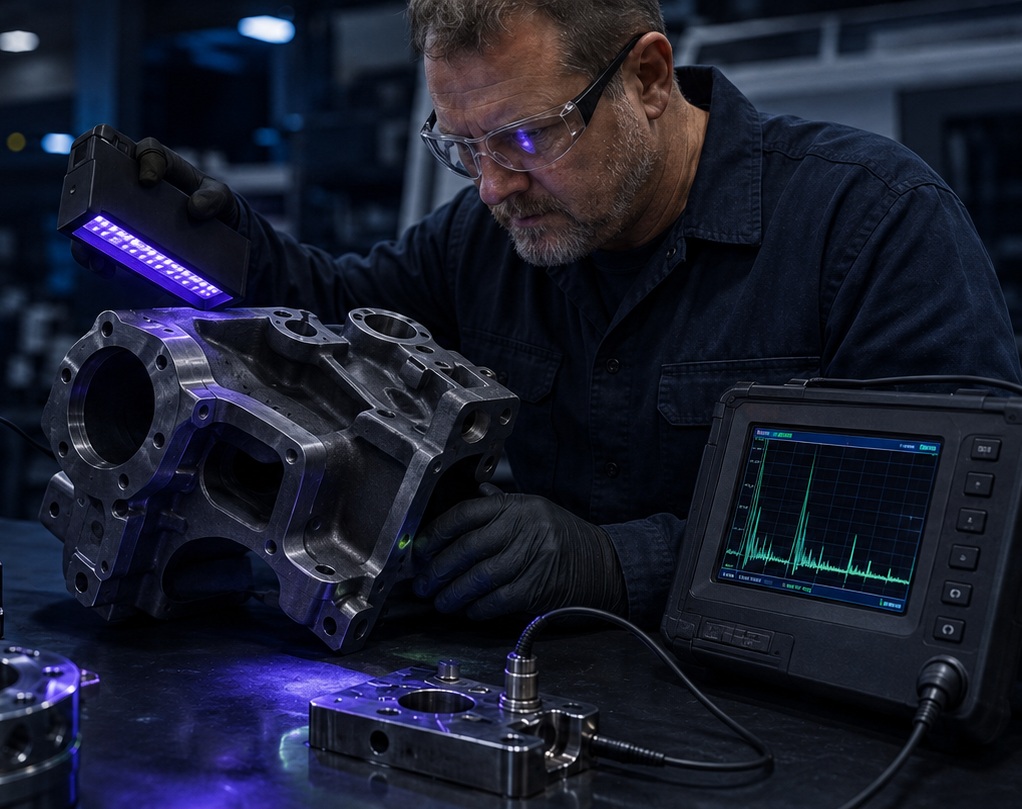
Liquid penetrant testing is a highly sensitive method for detecting surface-breaking flaws in non-porous materials. Our certified inspectors apply a penetrating dye to the part surface, allowing it to seep into any cracks, laps or porosity. After removing the excess penetrant, a developer draws the dye back to the surface, creating a visible indication of the flaw.
This method is best for detecting:
- Cracks
- Seams
- Laps
- Cold shuts
- Porosity
Our inspectors are certified to perform LPT in accordance with ASTM E1417 and NAS410 to provide clear documented results you can trust for your quality records.
Ultrasonic Testing (UT) – Available Now
Ultrasonic testing uses high-frequency sound waves to inspect a component’s internal structure. Our equipment transmits sound energy into the part and measures the reflections that return. Changes in the sound wave pattern indicate the presence of internal flaws (such as voids, inclusions or delaminations) that are invisible on the surface. Testing is performed in accordance with ASTM E164/E2700 and AWS D1.1 for weld inspection.
This method is especially valuable for:
- Detecting internal voids and inclusions
- Measuring material thickness
- Inspecting welds and bonded joints
- Verifying material integrity in complex geometries
Our ultrasonic testing provides a permanent and verifiable record of a component’s internal condition to support your quality documentation and traceability needs.
Magnetic Particle Testing (MPT) – Q3 2026
Magnetic particle testing is a method for detecting surface and near-surface defects in ferromagnetic materials. The part is magnetized and fine magnetic particles are applied to the surface. Defects cause a leakage field that attracts the particles and forms a visible indication.
We are targeting full certification and equipment validation for MPT by Q3 2026. This will add a third in-house NDT method to our capabilities, specifically suited for components made from steel, iron and other magnetic alloys.
Additional NDT Experience
While LPT and UT are our primary in-house services, our team also has direct experience with other testing methods crucial for critical applications. This includes helium leak testing, which we perform to verify vacuum integrity on components for semiconductor and other high-purity process equipment — a capability distinct from our in-house LPT and UT services. This background demonstrates the breadth of our team’s expertise across the NDT field. Note: visible dye penetrant testing is itself a method within our in-house LPT service, not a separate offering (see LPT above).
Certifications & accreditations





Why NDT Matters in Defense and Aerospace
In defense and aerospace, the cost of a single component failure can be catastrophic, not just financially, but in terms of safety, mission success and national security. Program managers and engineers can’t afford to take risks.
NDT provides the confidence you need:
- Safety. It identifies flaws that could lead to in-service failure, protecting the people who operate aircraft, vehicles and vessels.
- Compliance. Defense and aerospace contracts require adherence to stringent quality standards, including AS9100D and ISO 9001. NDT is often a mandatory part of the inspection process.
- Credibility. A supplier that performs rigorous in-house testing demonstrates a commitment to quality that procurement teams recognize and value.
For critical programs in aerospace, defense, and nuclear energy, NDT is a requirement. We have built our defense practice around meeting those requirements.
Integrated Manufacturing and Testing
One of the most significant advantages of having NDT in-house is the ability to integrate testing seamlessly into your production workflow.
Here is how it works:
- Your project moves through our machine shop for machining, fabrication or welding.
- When parts are ready for inspection, they move directly to our NDT team. No shipping, no waiting for an external lab’s schedule.
- Testing is performed promptly and results are documented in your quality package.
- Any necessary rework is handled immediately, with no delay from shipping parts back and forth.
The entire process is coordinated by your single point of contact to eliminate miscommunication and make sure the final product meets your specifications.
The result: A smoother workflow, faster delivery and a quality package that gives you complete confidence in your components.

Built on a Foundation of Quality
Our NDT services operate within a quality management system built to meet the highest industry standards:
- AS9100D Certified: The aerospace industry standard for quality management.
- ISO 9001:2015 Certified: International benchmark for quality management systems.
- ITAR Registered: Compliance with U.S. export control regulations.
- JCP Certified: Participation in the U.S. government’s Joint Certification Program.
- CMMC Compliant: Cybersecurity practices aligned with NIST SP 800-171 to protect your sensitive data.
Our quality system is a set of daily habits that keeps defect rates low and traceability tight.
01
What is the difference between liquid penetrant testing and ultrasonic testing?
What is the difference between liquid penetrant testing and ultrasonic testing?
Liquid penetrant testing (LPT) detects flaws that break the surface of a part, such as cracks, seams and porosity. Ultrasonic testing (UT) uses sound waves to detect flaws below the surface, including internal voids, inclusions and delaminations that LPT cannot reach. Many parts require both methods to fully verify integrity.
02
Does Specialty Machine perform NDT in-house or outsource it?
Does Specialty Machine perform NDT in-house or outsource it?
Liquid penetrant testing (LPT) and ultrasonic testing (UT) are performed in-house at Specialty Machine by certified inspectors. Magnetic particle testing (MPT) is targeted to come online in-house by Q3 2026. This eliminates the shipping time, scheduling delays and vendor hand-offs of outsourced testing.
03
What does magnetic particle testing detect, and when will it be available?
What does magnetic particle testing detect, and when will it be available?
Magnetic particle testing (MPT) detects surface and near-surface defects in ferromagnetic materials such as steel and iron. Specialty Machine is targeting full in-house certification and equipment validation for MPT by Q3 2026.
04
What standards and certifications apply to Specialty Machine's NDT services?
What standards and certifications apply to Specialty Machine's NDT services?
Specialty Machine’s NDT inspectors are certified to ASTM E1417 and NAS410 for liquid penetrant testing, and testing is performed in accordance with ASTM E164/E2700 and AWS D1.1 for ultrasonic weld inspection. Specialty Machine is AS9100D and ISO 9001:2015 certified, ITAR registered, JCP certified and aligned with CMMC/NIST SP 800-171 requirements.
05
Why would a defense or aerospace supplier choose an in-house NDT provider?
Why would a defense or aerospace supplier choose an in-house NDT provider?
An in-house NDT provider gives a single point of accountability for machining, fabrication and inspection, eliminates the lead time of shipping parts to an outside lab, and removes the finger-pointing that can occur between a machine shop and a third-party testing lab.
Get Your NDT Quote Today
If you are sourcing precision components for defense, aerospace or another mission-critical application and need a partner who understands the materials, the tolerances and the compliance requirements, we should talk.
Contact our team to discuss your program requirements or request a quote for your next project.